Disambiguation
How Tuned Global identifies which tracks are the same recording, scores its confidence, and delivers that information to you through the Catalogue feed and the broader API.
What disambiguation solves
A large music catalogue almost always contains the same recording more than once. The same song can arrive from different distributors, on different releases (single, album, compilation), at different audio qualities, or with slightly different titles and credits and each copy is stored as a separate track with its own track ID. That makes it hard to answer a simple question: “Are these two tracks actually the same recording?”
Disambiguation answers that question for you. It looks across the catalogue, decides which tracks represent the same underlying recording, groups them together, and attaches a confidence score that tells you how strong the evidence is. You no longer have to compare tracks yourself, the grouping and a transparent confidence level come built into the data you already receive.
The three things every track now carries
Disambiguation adds three values to each track. Together they tell you which group a track belongs to and how sure we are about it.
Disambiguation ID | The ID of the group (cluster) this track belongs to. Every track judged to be the same recording shares the same Disambiguation ID. A track with no match gets its own unique ID. This is only a grouping key(ID) and does not designate a parent or master track. |
Confidence score | A number from 95 to 100 indicating how strong the matching evidence is. Higher means stronger evidence. |
How tracks are matched
To decide whether two tracks are the same recording, we compare them using several independent signals, ranging from the most conclusive to the most general: an audio-level match, an identifier match based on ISRC, and a descriptive match based on details like artist and title. We only ever compare like-for-like content i.e. audio, video, karaoke and audiobook versions are never merged with one another.
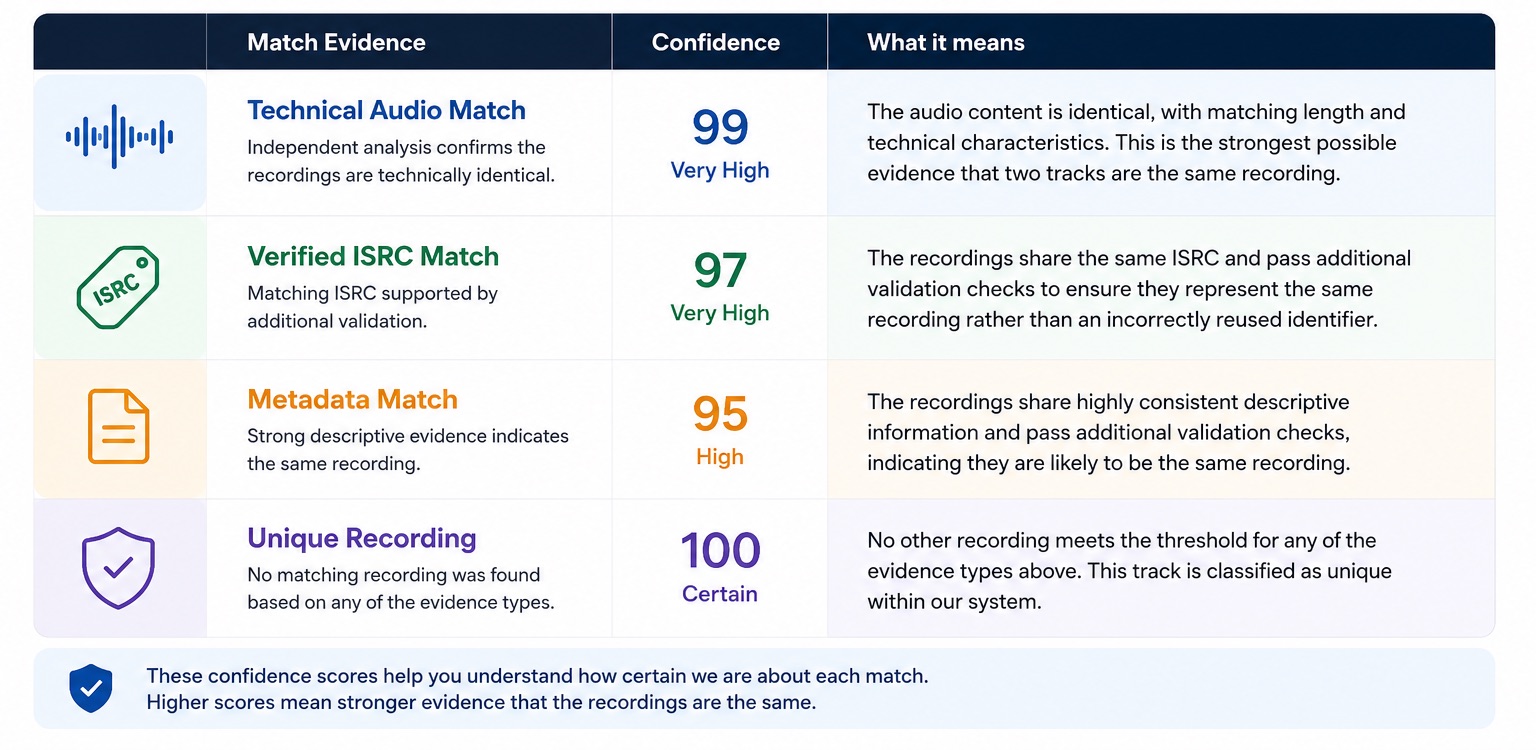
Each signal carries a confidence score, and where more than one applies to a track, the strongest one wins. Higher scores reflect more conclusive evidence. This is what you see in the confidenceScore and matchedOn values on every track:
Technical Audio Match | 99 | Independent analysis confirms the actual recordings are technically identical. This represents the strongest possible evidence that two tracks are the same recording. | A matching fingerprint means the audio is byte-for-byte identical, the strongest possible evidence. |
Verified ISRC Match | 97 | The recordings share the same ISRC and pass additional validation checks to ensure they represent the same recording rather than an incorrectly reused identifier. | ISRC should identify a recording uniquely, however it can be reused or mis-tagged. The additional checks protect against these errors. Explicit and non Explicit are never the same. |
Metadata Match | 95 | The recordings share highly consistent descriptive information and pass additional validation checks indicating they are likely to be the same recording. . | A reasonable match when no stronger identifier is available; a duration guard keeps different versions (e.g. a radio edit vs. an extended mix) apart. Explicit and non Explicit are never the same |
Where a match between products does NOT exist, then; | |||
Unique Recording | 100 | None of the above linked the track to anything else. | The track is unique in the catalogue, so we are fully confident it stands on its own. |
A short way to read the scores: 100 means "unique, nothing else like it"; 99 means "proven identical audio"; 97 means "same ISRC, double-checked"; 95 means "looks like the same recording by its details".
How DisambiguationIDs are assigned
Once tracks have been matched, every track found to be the same recording is grouped together under a single Disambiguation ID. Grouping is transitive: if one track is matched to a second, and that second to a third, all of them end up in the same group. Each track keeps the confidence score of the signal that placed it there.
Track 1001 | Identical Technical Audio Match with 1002 | 1001 | 99 | Identical Audio |
Track 1002 | Technical Audio Match with 1001 | 1001 | 99 | Identical Audio |
Track 1003 | Same ISRC as 1001 (additional Validation checks passed) | 1001 | 97 | Verified isrc matching |
Track 1004 | No match to any other recording | 1004 | 100 | Unique recordin |
Tracks 1001–1003 form one group (shared Disambiguation ID 1001); each keeps the score of the signal that linked it. Track 1004 stands alone. Note that ID 1001 is just the group's anchor (the earliest-delivered track), in your data it could even be a track you can't see, so treat it only as a shared label.
A note on ownership and what you see
Treat the Disambiguation ID purely as a grouping key. Its only meaning is "these tracks belong together", it does not mark a parent, master or preferred track for the group, and it implies no ranking or seniority among the tracks it links.
Behind the scenes, a group's Disambiguation ID is set to the ID of the track that was delivered to us earliest. That track simply acts as a stable anchor for the group: it may belong to a different owner and may not appear in your catalogue at all (for example, where you don't hold the rights to it). So the ID you see will sometimes not correspond to any track you can retrieve and that is expected. Use it only to identify which of your tracks share the same recording, never as a pointer to a single canonical track to keep for the whole group.
Grouping is calculated across the whole catalogue, so the matching is as accurate as possible. However, the data returned to you is always filtered to the Rights Holders you have rights to use. You see the disambiguation grouping for your own tracks; you never see tracks belonging to Rights Holders you don't have access to, even when they happen to fall in the same group.
Disambiguation data is refreshed on a daily cycle, so newly ingested tracks are picked up and grouped automatically.
How you receive disambiguation data
There are two delivery channels. Catalogue Feed (CF) for bulk, always-current data; and disambiguation API for on-demand lookups.
Catalogue Feed
The CDS JSON feed now includes a disambiguation node at the track level, carrying the three values described above. No change is required to consume it beyond reading the new node.
Example: a track that matched others by metadata:
 "disambiguation": {
    "disambiguationId": 128639973,
    "confidenceScore": 95
}
Example: a track that is unique in the catalogue:
 "disambiguation": {
    "disambiguationId": 128639976,
    "confidenceScore": 100
    }
Disambiguation API
An endpoint is available in both the Metadata and Delivery APIs:
GET tracks/{id}/disambiguation
It accepts either a track ID or an ISRC, and lets you look up the full group a recording belongs to (restricted to the owners you can access).
A track ID | We resolve the track’s Disambiguation ID, then return every track in that same group i.e. all the known duplicates of your track, filtered to the owners you have access to. |
An ISRC | We return all matching rows for that ISRC (track ID, disambiguation IDs, ISRC and owner ID), filtered to the owners you have access to. |
Neither | The request is rejected with a 400 error. |
Each returned record includes the track ID, the disambiguation ID(s), the ISRC and the owner ID, so you can map a recording to its full set of catalogue duplicates programmatically.
What this means for you
Because every track carries its group's Disambiguation ID, you can recognise when several tracks are really the same recording and act on it across your product. Common uses include:
- Cleaner search results: Collapse duplicate recordings so a search returns one entry per recording instead of many near-identical hits.
- Use the Disambiguation ID along with the confidence score to determine which recording to display. We recommend using this data along with original recording date and to prioritise Track Artist ID and Album Artist ID where they are identical as this will ensure songs from compilation albums do not appear in place of songs from the Artists album.
- Duplicate-free recommendations: Avoid recommending the same recording more than once (e.g., the single and the album version) in "more like this," radio, or discovery feeds.
- Duplication-free playlist: Prevent the same recording being added to a playlist twice, even when the user picks it from a different release.
- You may provide this a hard or soft warning
- Resilient playback: If a track becomes unavailable (for example, it's taken down), automatically substitute another track in the same group, using the shared Disambiguation ID, so playlists and saves keep working.
- Unique-catalogue analytics: Count distinct recordings rather than raw track totals, for a truer picture of catalogue size, overlap and coverage.
Quick reference
100 | Unique Recording | Unique - no other track matched it. | |
99 | Technical Audio Match | Identical audio fingerprint (MD5). | |
97 | Verified ISRC Match | Same ISRC, with duration and title checks passed. | |
95 | Metadata Match | Same artist, title and duration. |
Guard rails applied to every match: same content type required; duration within ‘x’ seconds; titles similar with fuzziness for ISRC matches. The Disambiguation ID is only a grouping key, it groups tracks that are the same recording and does not designate a parent or preferred track. Grouping is catalogue-wide; results are always filtered to owners you can access; data refreshes daily.


On this page
- Disambiguation